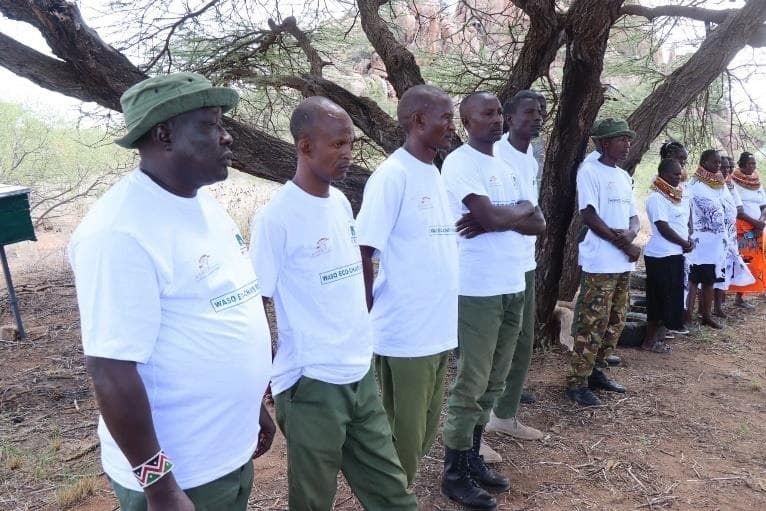
Waso Eco-Champions Plant 10,000 Indigenous Trees Across Isiolo County
ASREP Africa's flagship Waso Eco-Champions programme has reached a landmark milestone: 10,000 indigenous trees planted across 10 wards of Isiolo County, mobilising over 2,000 community eco-champions in one of Kenya's most ambitious community-led restoration efforts.
In a landscape shaped by drought, seasonal floods, and decades of land degradation, 2,000 community members across Isiolo County have become the front line of ecological restoration. ASREP Africa's Waso Eco-Champions programme has now achieved a landmark milestone: 10,000 indigenous trees planted across all 10 wards of Isiolo County, Kenya.
The programme, launched as part of ASREP Africa's Climate Resilience programme, was designed with a clear conviction — that sustainable environmental restoration must be community-led, community-owned, and community-sustained. In Kenya's arid and semi-arid lands (ASALs), which cover approximately 84% of the country's landmass, this conviction is not idealistic. It is existential.
What the Waso Eco-Champions Do
Eco-champions are not merely tree planters. They are trained community stewards who monitor vegetation cover, report encroachment, engage local leaders, educate neighbours, and act as first responders when grazing pressure or charcoal burning threatens restored areas. Each ward has a cohort of eco-champions who meet regularly, share observations, and report to ASREP's programme team.
Get field updates from Kenya's ASALs
Join our community of supporters receiving ASREP's latest news and impact stories.
Subscribe to updates →Day-to-day, an eco-champion might spend the morning checking on a recently planted acacia grove, spend the afternoon in a baraza educating younger community members about why certain tree species are protected, and end the day documenting observations in a simple field form. Over 2,000 community members now hold this role across Isiolo's 10 wards.
"The trees we plant today are the shade our grandchildren will rest under. In the Borana culture, you do not own the land — you are a steward of it for those who come after you."
Species Selection: Going Indigenous
A core principle of the Waso Eco-Champions programme is the exclusive use of indigenous tree species — those that evolved in this specific ecological zone and that pastoral communities have relied on for generations. The primary species include Acacia tortilis (umbrella thorn acacia), Acacia senegal (gum arabic), Commiphora species (myrrh and related trees), and Balanites aegyptiaca (desert date).
These are not ornamental choices. Acacia tortilis provides browse for livestock during dry seasons, nitrogen-fixing that improves soil fertility, and shade that reduces soil moisture loss. Commiphora species are harvested for frankincense and myrrh, providing direct income for families. Balanites produces edible fruits and seed oil used in traditional medicine. Every tree planted is a multi-function ecological and economic asset.
The selection of species was guided by participatory consultations with community elders, women groups, and the Kenya Forest Service (KFS), ensuring that restoration aligned with both ecological needs and cultural memory.
Partnerships: KFS, KWS and Community Government
The Waso Eco-Champions programme operates in formal partnership with the Kenya Forest Service and the Kenya Wildlife Service. KFS provides technical guidance on species selection, seedling production protocols, and monitoring methodology. KWS contributes landscape-level intelligence, particularly regarding how restoration areas interact with wildlife corridors in and around the Isiolo region.
The programme also works closely with ward administrators and county government structures, ensuring that restored areas are recognised in local land-use plans and that eco-champions have formal standing when reporting violations. This institutional embeddedness is what distinguishes the programme from project-based tree-planting drives that fade when donor funding ends.
Climate Adaptation Context
Isiolo County has experienced increasing climate volatility over the past two decades — longer dry spells, more intense flash floods, and greater unpredictability in the onset of rains. These shifts destabilise the pastoral livelihood system, which depends on seasonal movement to access water and pasture.
Ecological restoration addresses climate vulnerability in multiple ways. Tree cover slows erosion and retains topsoil during heavy rains. Root systems improve soil water infiltration, recharging shallow wells and seasonal rivers. Vegetation cover reduces surface temperatures. And restored landscapes support the recovery of grasses and shrubs that provide the pasture base for livestock.
ASREP Africa frames ecological restoration not as an environmental programme separate from livelihoods, but as a foundational investment in the climate resilience of pastoral communities themselves. The 10,000 trees planted to date represent a beginning, not an endpoint.
Community Benefit and the Road Ahead
Beyond environmental outcomes, the Waso Eco-Champions programme has generated direct community benefits. Nursery operations have provided seasonal income for women's groups. Youth have been employed as field monitors. Schools have integrated tree stewardship into their activities. Communities that were once passive recipients of government conservation messaging are now active ecological managers.
ASREP Africa's target is ambitious: to expand the programme to neighbouring counties in Kenya's northern ASAL corridor while deepening the ward-level cohort model in Isiolo. The organisation is also working to develop verified carbon sequestration metrics for the programme, opening a potential pathway to community carbon finance that would create a sustainable funding base independent of external grant cycles.
Learn more about our climate resilience programme and how ASREP Africa is working to build ecological and human resilience across Kenya's ASALs.
Share this story
