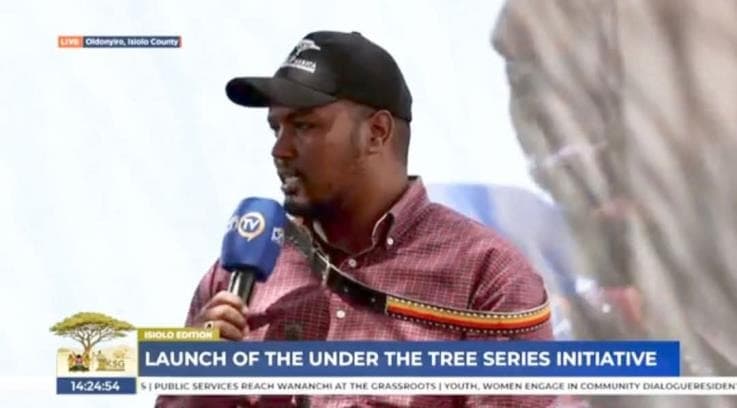
KSG 'Under the Tree' Civic Education Series Goes National
A landmark partnership with the Kenya School of Government scales the Isiolo-piloted civic education model to all 47 Kenyan counties — a testament to ASREP's community-sourced civic education approach and its national policy resonance.
There is a particular kind of civic knowledge that does not emerge from textbooks or government pamphlets. It lives in community gatherings, in the questions elders ask about who owns the land, in the discussions women have about why their names do not appear on title deeds, in the frustrations young people express about why their voices are absent from county planning processes. It is this knowledge — grounded, specific, and urgent — that ASREP Africa's partnership with the Kenya School of Government (KSG) is designed to centre.
The "Under the Tree" series, piloted in Oldonyiro ward in Isiolo County, has now been formally adopted by the Kenya School of Government for rollout across all 47 Kenyan counties. The announcement represents one of the most significant national policy outcomes in ASREP Africa's short history, and a validation of a civic education approach that deliberately rejected conventional classroom-based instruction.
What "Under the Tree" Means
The name is literal and intentional. Civic education sessions in the "Under the Tree" series are conducted outdoors, in community spaces, under trees — the same spaces where pastoral communities have historically gathered for governance, dispute resolution, and collective decision-making. This choice is not aesthetic. It is structural.
Get field updates from Kenya's ASALs
Join our community of supporters receiving ASREP's latest news and impact stories.
Subscribe to updates →In Kenya's ASAL communities, the physical location of learning carries cultural weight. A government office or classroom carries associations of bureaucracy, literacy requirements, and power differentials. An open-air community space, by contrast, signals belonging. It communicates that the knowledge being shared belongs to everyone present, not just those with formal education.
"When we sit under the tree together, we are not students and teacher. We are community members thinking together about how we govern ourselves. That is the spirit of the Under the Tree series."
The Oldonyiro Pilot
The pilot in Oldonyiro, a ward in Isiolo's North Isiolo constituency, was designed to test whether a participatory civic education model could generate genuine civic engagement in a community that has historically been marginalised from formal governance processes. The results exceeded expectations.
Participants included women, youth, pastoralists, small traders, and community elders — demographics that do not typically attend formal civic education events. Attendance was high and sustained across multiple sessions. Participants demonstrated measurable gains in knowledge about county budget processes, land rights, and community participation mechanisms. More importantly, several participants went on to engage directly with ward-level governance structures following the programme.
The pilot was documented and evaluated by ASREP Africa's Research and Knowledge programme, providing the evidence base that KSG used to make the case for national adoption.
Prof Nura Mohamed's Dual Role
The partnership between ASREP Africa and the Kenya School of Government carries a distinctive dimension: Prof Nura Mohamed, who serves as Director General of the Kenya School of Government, is also the Chairman of ASREP Africa's Board of Directors. This dual role means that the institutional relationship between ASREP and KSG is not simply a transactional partnership but a deep alignment of vision and institutional leadership.
Prof Mohamed has championed the idea that civic education in Kenya must be decolonised — that it must speak in community languages, respect indigenous governance traditions, and engage citizens as active agents rather than passive recipients of government information. The "Under the Tree" series embodies this vision, and its national adoption through KSG represents a significant institutional endorsement.
Why ASAL Communities Need This
Kenya's ASAL communities have been historically underserved by civic education programmes. Distance from government offices, low formal literacy rates, language barriers, and the seasonal mobility of pastoral livelihoods have all made conventional civic education inaccessible. The consequences are visible in governance data: ASAL counties consistently record lower civic participation rates, lower awareness of county budget processes, and lower uptake of government social protection programmes.
The "Under the Tree" model addresses these structural barriers directly. By taking education to the community, conducting sessions in local languages, using participatory and visual methods that do not depend on literacy, and partnering with existing community governance structures, the series reaches citizens who have been systematically excluded from civic life.
The 47-County Rollout
The national rollout will be phased. The first wave, beginning in 2026, will focus on ASAL counties — the 23 counties classified as arid or semi-arid — where the civic education gap is most acute and where ASREP Africa's existing networks and knowledge can support programme implementation. Subsequent phases will expand to all 47 counties.
KSG will lead the rollout as the formal implementing institution, drawing on its national infrastructure and trainer networks. ASREP Africa will provide technical support, particularly on the participatory methodology, ASAL community engagement approaches, and monitoring frameworks.
The 47-county rollout of "Under the Tree" represents a rare example of a community-sourced innovation in Kenya's ASALs achieving national policy adoption. It reflects ASREP Africa's conviction that the knowledge and governance capacity needed to transform Kenya's marginalised regions already exists within those communities — and that the role of organisations like ASREP is to amplify it, not to import alternatives from elsewhere.
Explore more about ASREP Africa's civic governance programme and how we are building inclusive governance across Kenya's ASALs.
Share this story
